


Daniel Julien’s new book on AI: a must-read from the founder of Teleperformance
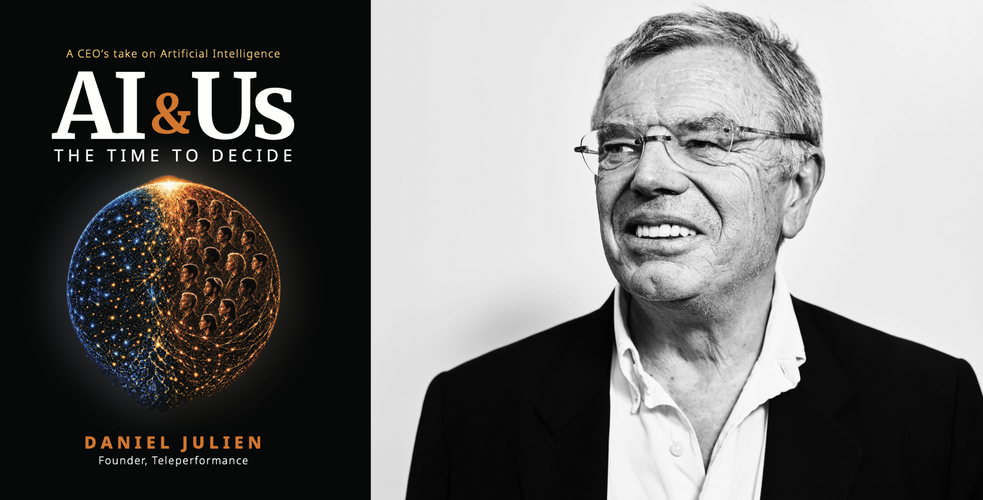
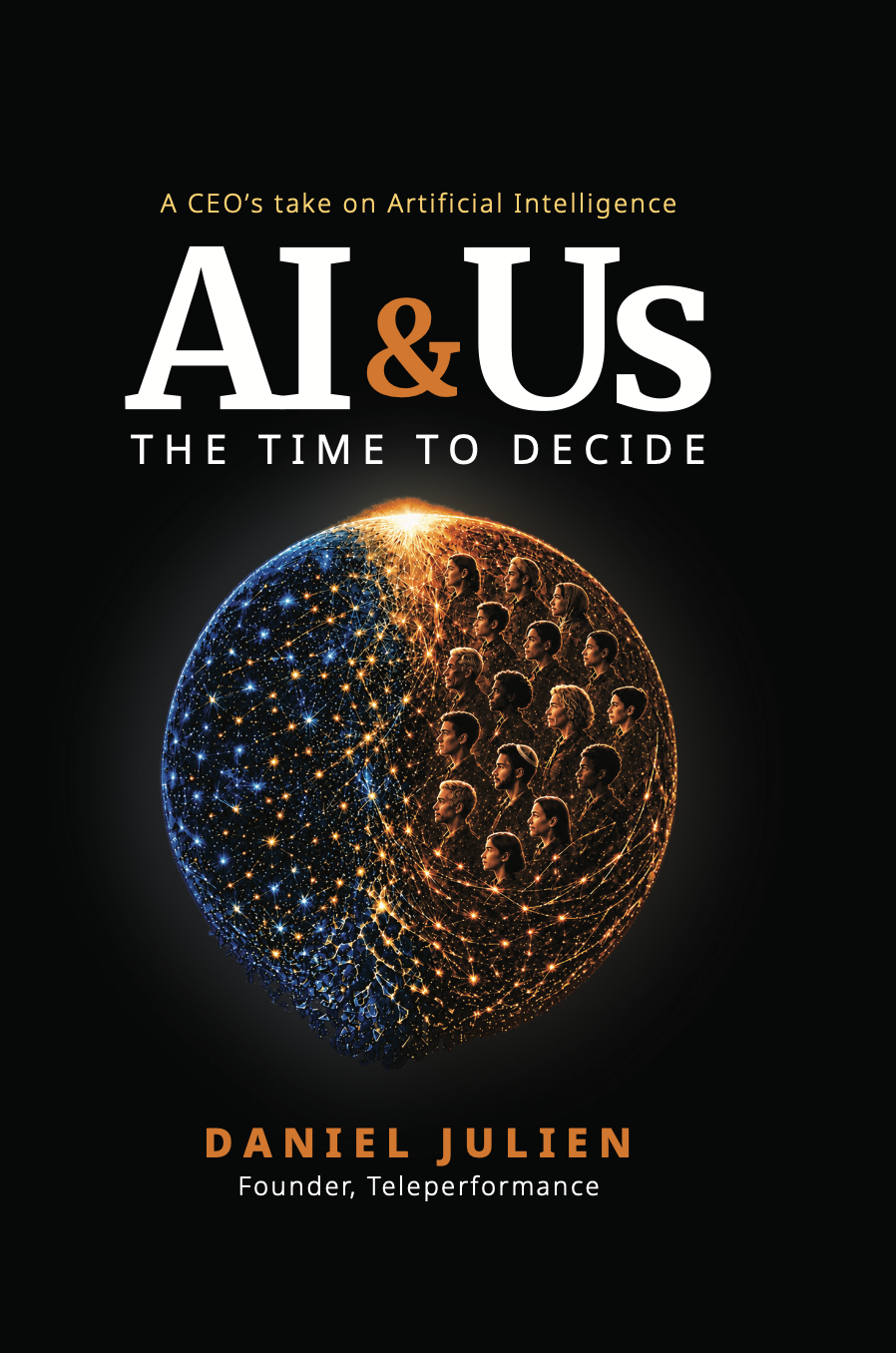
“Here I am, back in Miami Beach, after a short trip to China.” Those are the first words of a book I received overnight, as a PDF. And I read it: “AI & Us, the time to decide”. It went on sale on Amazon yesterday, November 12. Not at Fnac in France, too bad, but more on that later.
En-Contact strongly recommends reading it, along with two other books released in recent months. So buy them, don’t steal them, as has become common practice among certain pirates.
This book was written by a gentleman who has played a major role in our lives, mine and yours, without you necessarily knowing it: he and the nearly 500,000 employees his company has employed, or still employs, all over the planet. His family, as he calls it at the end of the book: TP, Teleperformance. These people hold conversations with other human beings. They say machines could replace them.
The author and AI’s impact on his life: his baby, which entered and left the CAC 40
The last time I received an email from Daniel Julien, late one night, a deputy minister in Colombia’s government had posted a tweet. An unfounded tweet. Even so, TP’s share price had plunged 30% in the days that followed. Some messages, some books, written quickly or not, and published, are ones you don’t forget.
I read it, not all of it, but enough that the start of the “meal” makes me want to devote more time to it, however long it takes. I’m not waiting to share my view with you, because these days everything moves fast: a film, a book, a conversation relayed too quickly or cut short can influence the course of events.
Its author is wealthy, lives in Miami, and in 1978 founded the world’s number one call center company, Teleperformance, now known as TP: when it comes to the economy, services, decisions, the impact of AI on his daily life, his profession, a company’s valuation. Daniel Julien turned his small company, started with ten phone lines in a Paris office, into a group present in nearly a hundred countries, the world leader in outsourced customer experience.
He wrote this book after “seeing his industry lose 75% of its market value in three years, convinced that artificial intelligence would replace human customer service—a certainty that, to date, the facts have not borne out.”
A moment of discernment
(…) This book does not predict the future. It gives you the keys to understand it, so that you can make an informed choice right now, at the moment when the most decisive turning point of the twenty-first century is taking shape. The Greek word Krisis originally did not denote a catastrophe. It denoted a decision, a judgment, a moment of discernment in which one separates what must be kept from what must be set aside. That is the meaning I give to this subtitle. We are not going through a crisis generated by artificial intelligence in the sense that we would be suffering a disaster. We are going through a moment whose outcome depends on a choice, and where the absence of a choice would itself be a choice, the worst of all. This book attempts to set out the terms of this choice clearly, so that everyone can take part (…) Excerpt from the first pages.

What can we do, what should we do, is there still time?
At a literary breakfast we co-organized, devoted to a book on AI and its pioneers, with its author, Guillaume Grallet, in attendance, a participant asked the author an instructive question: “What can we do, is there still time?” Daniel Julien’s book speaks to precisely this: the moment we are living through, the past and future impact of AI on us human beings and on the planet, and the choices before us. The way it lays out the stakes is well documented, rich, almost scientific, yet illustrated with enough concrete examples to guarantee a read free of boredom. If I had to give just one argument, this is what is worth remembering about the book and why it matters. On page 18, learn what Moravec’s paradox is, formulated in 1988: “perception costs infinitely more in computing power than logic”; on page 20: “Invisible AI: Tashkent, Uzbekistan, May 2026. I came across a beggar in a wheelchair wearing a chain around his neck with a personal QR code dangling from it, for receiving contactless donations.” What follows is an accessible presentation of the same four building blocks, which should be named once and for all: the algorithm, data, computing power, architecture, the framework…
Whether you are a call center agent, a stock analyst, a lawyer, or a janitor. A dad or mom wondering whether to spend €7,000 or €8,000 a year, for several years, even taking out a loan, to pay the significant bill for your teenager’s education. Who wants to get into Penninghen or IÉSEG… or switch to a bac pro (vocational baccalaureate) in ICCER (heating, air-conditioning, and renewable-energy installation). Personally, if I were fifteen in 2026, I’d lean toward the latter.
With this author, you won’t waste your time or your money
I met with Daniel Julien at length three times, in Fort Lauderdale and in Paris. The interviews were always dense and shook me up. I also went to Colombia to visit TP’s rather secretive centers, the ones where content moderation takes place. For TikTok, Meta, and many others (Trust & Safety). This guy doesn’t waste your time, I thought after each of our conversations and site visits. You won’t waste yours, nor the twenty-four euros you may spend on buying this book. And on reading it!

Lately, I’ve read a few books: one on the band Téléphone, written by their manager, François Ravard. The saga of M6 and the career of Nicolas de Tavernost. I’ve skimmed, without finishing yet, End Times by Peter Turchin. An incredibly lucid book and thesis. My wife swiped it from me. Normally she doesn’t read any economics books, but here everything is mixed together: sociology, economics, history. She read it in one sitting, delighted, a good sign… “Read attentively and tirelessly. Read the notices, the posters, read the enameled signs or the crumpled papers in the wastebasket, read over your neighbor’s shoulder, but read!” wrote Louis Calaferte in Septentrion.
Acknowledgments: “I learned so much on rue Firmin Gillot”
Angela, Daniela, Tara, and many other women are thanked at the end of the book. As are Moulay Hafid Elalamy, Philippe Ginestie, and the TP family. I’m dwelling on these acknowledgments because they say a lot, I believe, about the author’s personality. No need to say more; those who worked at Teleperformance and alongside the author will understand. Some have explained it in another book.
The rest of our review will appear in En-Contact issue 141, out in early December, along with the two other books we suggest reading.
Manuel Jacquinet